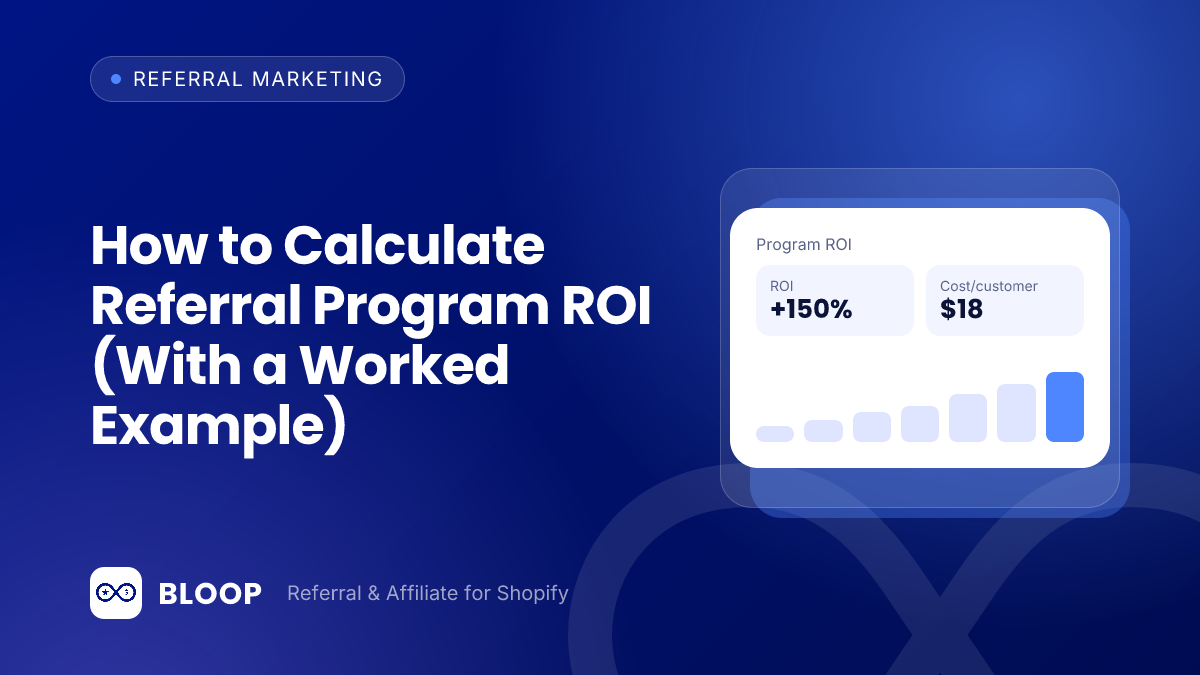
Referral program ROI is the profit your referred orders generate, minus everything the program costs you, divided by what it costs you. In formula form: ROI (%) = (gross profit from referred orders – total program costs) ÷ total program costs × 100. A result above 0% means the program has paid for itself over the period you measured, and you should measure it two ways: on first orders only, and over the lifetime of the customers it brings in.
The arithmetic is simple; the inputs are where it goes wrong. Stores count revenue instead of profit, forget the discount they gave away, or credit the program with orders that would have happened anyway. Below you will find the formulas, the costs to include, a 12-month worked example, payback, sensitivity tables and a method for attributing orders. Every figure in the worked example is hypothetical, and every research figure is linked to the page where we read it. To skip the arithmetic, use the free referral ROI calculator.
Key takeaways
- Measure ROI on profit, not revenue. In the example below, the revenue-based figure is eight times the profit-based one.
- Run two views: first-order ROI (13.6% over 12 months in the example) and lifetime ROI that adds repeat orders (41.1%). Report both.
- Payback is when cumulative net profit turns positive. In the example it happens in month 3, but only because the combined reward ($25) stays well below the $35 profit on a first order.
- Reward size and order value move ROI more than conversion rate does. A combined reward of $30 on a $70 order at 50% margin cuts first-order net profit to $0.10 in a 24-customer month.
- Adjust for incrementality. If only about 71% of referred customers are truly new demand, the 12-month example breaks even; below that it loses money.
- Attribute orders with unique codes and links, tag shared URLs with UTM parameters, and cross-check against Shopify’s marketing, discount and customer reports.
Two ways to measure referral ROI: first-order and lifetime
A referral program pays off twice. The first payoff is the profit on the referred customer’s first order, which you can measure on day one. The second is the profit from later orders, which arrives over months and depends on how many customers come back. Mixing the two is the most common reason two people calculate different ROI for the same program.
| Metric | Formula | Question it answers |
|---|---|---|
| First-order ROI | (Gross profit on first orders – total costs) ÷ total costs × 100 | Does the program pay for itself on the first purchase alone? |
| Lifetime ROI | (Gross profit on first and repeat orders – total costs) ÷ total costs × 100 | Does it pay for itself once referred customers reorder? |
| Cost per acquired customer | Total costs ÷ new customers acquired | How much does one referred customer cost me, fully loaded? |
| Payback period | Month in which cumulative net profit first reaches 0 or more | How long is cash tied up in the program? |
ROI (%) = (Gross profit from referred orders – Total program costs) ÷ Total program costs × 100
- Gross profit from referred orders = referred revenue at full price × gross margin %. Use revenue before any referral discount, because the discount goes on the cost side.
- Total program costs = referee discounts + referrer rewards + app fees + affiliate commissions + staff time + fraud and reversal losses.
The BLOOP calculator page states a revenue-based formula, Net ROI (%) = (Referred Revenue – Total Costs) ÷ Total Costs × 100, and says anything above 100% indicates positive ROI. That is a high bar suited to revenue input. If you enter gross profit instead (check the tool’s labels), the break-even line is 0%, the standard used in this post.
What research says about the value of referred customers
An academic study that tracks real customers over time is “Referral Programs and Customer Value” by Philipp Schmitt, Bernd Skiera and Christophe Van den Bulte (Journal of Marketing, January 2011). You can read the full paper on the Wharton faculty site. Because it follows real customers rather than survey answers, it is more useful for ROI modeling than a survey.
| Finding | Figure | Where it comes from |
|---|---|---|
| Sample | 5181 referred customers and 4633 randomly sampled nonreferred customers of a German bank, all acquired in 2006 | Schmitt, Skiera and Van den Bulte (2011) |
| Observation window | 33 months, from acquisition until September 2008 | Same paper |
| Referral reward | 25 euros as a voucher for the existing customer who brought in a new one | Same paper |
| Retention at 33 months | 82.0% of referred customers still active versus 79.2% of nonreferred customers | Same paper |
| Six-year customer value | Referred customers about 16% more valuable than comparable nonreferred customers (average nonreferred value of 253 euros, a differential of about 40 euros) | Same paper |
| Return on the reward | About 60% return on the 25 euro reward over a six-year span | Same paper |
| Contribution margin gap | Higher at first, but the expected advantage disappears after 857 days, about 29 months | Same paper |
The paper reports that the margin advantage of referred customers shrinks over time while the retention advantage persists. Our own check of its numbers: a differential of about 40 euros on a 25 euro reward is (40 – 25) ÷ 25 = 60%, matching the roughly 60% the authors report. That is the logic of lifetime ROI, with the reward as the cost and the extra customer value as the return.
Four more findings from the same paper are useful when you set your own assumptions:
- Margin per day. Nonreferred customers averaged 30 cents of contribution margin per day. After controlling for demographics and acquisition month, referred customers earned 7.6 cents per day, or 27.74 euros per year, more. Check: 0.30 × 365 = 109.50 euros a year, and 27.74 ÷ 109.50 = 25.3%, the roughly 25% the authors report.
- Churn. With the same controls, referred customers who were still active were about 18% less likely to defect at any point in time.
- Acquisition cost. The authors say the total acquisition cost of a referred customer was about 20 euros lower than for other customers. Including that difference, the value gap is approximately 25% instead of 16%.
- Who benefits. The authors find the referral program was less beneficial when used to acquire older customers or low-margin customers, which is why they recommend targeting it selectively.
Three cautions. The data comes from one bank in 2006, not online retail, so these percentages are not benchmarks for a Shopify store. The authors say the value gap varies across customer segments and recommend a selective approach. And they note that programs paying a reward regardless of how long the new customer stays are prone to abuse.
On trust, the Nielsen Global Trust in Advertising Report (September 2015) found that 83% of global respondents said they completely or somewhat trust recommendations from friends and family, and 66% said the same about consumer opinions posted online. The survey polled 30,000 online respondents in 60 countries, and Nielsen notes the responses reflect claimed behavior rather than actual metered data. That is a statement about trust, not profit: it supports testing a program but says nothing about what yours will earn.
Which costs to include
A program’s cost is more than the reward you advertise. Count each of these for the same period as your revenue.
| Cost | What to count | Notes |
|---|---|---|
| Referee discount | Discount value on every referred first order that used the code | The margin you give up on the new customer’s order |
| Referrer reward | Discount codes redeemed, store credit issued or redeemed, free products at cost, cash paid out | Face value is the conservative choice; redeemed value is more precise. BLOOP’s documentation lists discount coupon, store credit, free product, cash (tracked in BLOOP, paid by you) and custom rewards for referrers |
| App fee | Monthly subscription for your referral app | BLOOP’s Free plan is $0 and covers 10 referee orders and 10 affiliate orders; Premium is $59.90/month with unlimited orders |
| Affiliate commission | Payouts on affiliate-referred orders | See how referral commission works if you run both programs |
| Transaction fees on store credit | Fees charged when customers pay with credit | Shopify says that for stores created on or after May 12, 2025, orders that include store credit as a payment method are charged third-party transaction fees, and that the fee is waived for stores on the Shopify Plus plan with Shopify Payments activated (Shopify store credit help) |
| Staff time | Hours spent on setup, support and reviewing rewards, at your hourly cost | Easy to forget; in the example below it is about as large as the app fee |
| Fraud and reversals | Rewards paid on orders later canceled or refunded, plus abuse you did not catch | See our guide to referral fraud and the controls that prevent it |
Two cautions on reversals. Remove refunded or canceled orders from revenue. And check what your tool does with the reward: BLOOP’s documentation says rewards are revoked by default on cancel or refund, that an order counts as refunded once 90% or more of its item value has been refunded (shipping not counted), and that a reward counts as earned at Paid status by default with a default review period of 6 hours. Rewards paid on orders later returned belong in your cost line.
Store credit has its own trap. Shopify’s help page says credit expiration is set per issuance (an expiry date or none) and that customers can use credit as a payment method only when signed in through customer accounts or using Shop Pay. Unspent credit is still owed to the customer, which is why this post counts it at face value. Shopify lists “Store credit transactions” and “Outstanding store credit balance” reports under Analytics, Reports, Finances.
The reward you choose changes which cost line it lands in. BLOOP’s rewards documentation lists five referrer rewards and two referee rewards:
- Discount coupon (referrer or referee): a Shopify discount code, fixed or percentage. Count the discount value on orders that actually redeem it.
- Store credit (referrer): applied to the customer’s account. Count it at face value, as above.
- Free product (referrer or referee): up to five items on the next order. Count the products at your cost.
- Cash (referrer): tracked in BLOOP, with a manual payout by you. The payout, and the time spent making it, are both costs.
- Custom (referrer): a self-described reward that needs manual approval, so it carries staff time.
The example store (hypothetical numbers)
Every figure from here on is invented for illustration. They are not benchmarks, and your results will differ. Assume a store that launches a referral program with these inputs:
| Input | Value | Why it is set this way |
|---|---|---|
| Average order value at full price | $70 | A mid-priced consumer product |
| Gross margin | 50% | Gross profit is $70 × 50% = $35 per order |
| Referee reward | $15 off the first order | A discount code on the new customer’s first order |
| Referrer reward | $10 store credit per referred order, counted at face value | Combined reward of $25 per referred order |
| App fee | $59.90 per month | BLOOP Premium, unlimited orders |
| Staff time | $60 per month | 2 hours at $30 per hour |
| Repeat behavior | 30% of referred customers place exactly one more full-price order within 90 days, spread evenly as 10% in each of the 3 months after the acquisition month | No reward is paid on repeat orders. Customers acquired in months 10 to 12 are still inside their repeat window at month 12 |
| New referred customers per month | 8, 12, 16, 20, then 24 per month from month 5 | A ramp as the program becomes known |
From those inputs, three unit figures drive everything else:
- Gross profit per order: $70 × 50% = $35.00
- Variable cost per referred first order: $15 + $10 = $25.00, which leaves $35 – $25 = $10.00 of contribution per first order
- Fixed monthly cost: $59.90 + $60 = $119.90
One steady-state month, first orders only
Take a month with 24 new referred customers, which is what the table below reaches from month 5.
- Gross profit: 24 × $35 = $840.00
- Variable costs: 24 × $25 = $600.00
- Total costs: $600.00 + $119.90 = $719.90
- Net profit: $840.00 – $719.90 = $120.10
- First-order ROI: $120.10 ÷ $719.90 × 100 = 16.7% (rounded)
- Cost per acquired customer: $719.90 ÷ 24 = $30.00 (rounded), against $35 of first-order gross profit
For comparison, a revenue-only calculation on the same month gives 24 × $70 = $1,680, then ($1,680 – $719.90) ÷ $719.90 × 100 = 133.4% (rounded). Same program, eight times the apparent return, because it treats the cost of the products you shipped as if it were free. Use the profit-based number to make decisions.
Worked example: 12 months, month by month
Now run the same store for a year. The repeat orders in each month come from the customers acquired in the previous three months, at 10% of each cohort per month. First-order profit is new customers × $35, repeat profit is repeat orders × $35, and costs are new customers × $25 + $119.90.
| Month | New customers | Repeat orders | First-order profit | Repeat profit | Costs | Net profit | Cumulative net |
|---|---|---|---|---|---|---|---|
| 1 | 8 | 0.0 | $280.00 | $0.00 | $319.90 | -$39.90 | -$39.90 |
| 2 | 12 | 0.8 | $420.00 | $28.00 | $419.90 | $28.10 | -$11.80 |
| 3 | 16 | 2.0 | $560.00 | $70.00 | $519.90 | $110.10 | $98.30 |
| 4 | 20 | 3.6 | $700.00 | $126.00 | $619.90 | $206.10 | $304.40 |
| 5 | 24 | 4.8 | $840.00 | $168.00 | $719.90 | $288.10 | $592.50 |
| 6 | 24 | 6.0 | $840.00 | $210.00 | $719.90 | $330.10 | $922.60 |
| 7 | 24 | 6.8 | $840.00 | $238.00 | $719.90 | $358.10 | $1,280.70 |
| 8 | 24 | 7.2 | $840.00 | $252.00 | $719.90 | $372.10 | $1,652.80 |
| 9 | 24 | 7.2 | $840.00 | $252.00 | $719.90 | $372.10 | $2,024.90 |
| 10 | 24 | 7.2 | $840.00 | $252.00 | $719.90 | $372.10 | $2,397.00 |
| 11 | 24 | 7.2 | $840.00 | $252.00 | $719.90 | $372.10 | $2,769.10 |
| 12 | 24 | 7.2 | $840.00 | $252.00 | $719.90 | $372.10 | $3,141.20 |
| Total | 248 | 60.0 | $8,680.00 | $2,100.00 | $7,638.80 | $3,141.20 | $3,141.20 |
Check the totals. New customers: 8 + 12 + 16 + 20 + (8 × 24) = 248. Repeat orders: 0 + 0.8 + 2.0 + 3.6 + 4.8 + 6.0 + 6.8 + (5 × 7.2) = 60. First-order profit: 248 × $35 = $8,680.00. Repeat profit: 60 × $35 = $2,100.00. Costs: 248 × $25 = $6,200.00, plus 12 × $119.90 = $1,438.80, which is $7,638.80.
First-order and lifetime ROI for the year
- First-order ROI: ($8,680.00 – $7,638.80) ÷ $7,638.80 × 100 = $1,041.20 ÷ $7,638.80 × 100 = 13.6% (rounded)
- Lifetime ROI with repeat orders: ($8,680.00 + $2,100.00 – $7,638.80) ÷ $7,638.80 × 100 = $3,141.20 ÷ $7,638.80 × 100 = 41.1% (rounded)
- Fully loaded cost per acquired customer over the year: $7,638.80 ÷ 248 = $30.80 (rounded)
The lifetime figure is conservative: customers acquired in months 10 to 12 still have 2.4 + 4.8 + 7.2 = 14.4 repeat orders ahead in months 13 to 15, worth 14.4 × $35 = $504.00 that is not in the table. Counting it gives ($3,141.20 + $504.00) ÷ $7,638.80 × 100 = 47.7% (rounded). We left it out because it has not happened yet.
| 12-month result | Figure | How it is calculated |
|---|---|---|
| Total program costs | $7,638.80 | $6,200.00 rewards + $1,438.80 fixed costs |
| First-order ROI | 13.6% | $1,041.20 ÷ $7,638.80 |
| Lifetime ROI (repeat orders in the window) | 41.1% | $3,141.20 ÷ $7,638.80 |
| Lifetime ROI including the 14.4 repeat orders still to come | 47.7% | $3,645.20 ÷ $7,638.80 |
| Revenue-only ROI on first orders (not recommended) | 127.3% | (248 × $70 = $17,360.00; $17,360.00 – $7,638.80) ÷ $7,638.80 |
| Fully loaded cost per customer | $30.80 | $7,638.80 ÷ 248 |
Payback period
Payback tells you how long you waited, which matters if you fund rewards from cash.
Program payback
Cumulative net profit is -$39.90 after month 1 and -$11.80 after month 2, then turns positive at $98.30 in month 3, so the program pays back in month 3. On first orders alone it is the same month, but only just: first-order net profit is -$39.90, $0.10 and $40.10 in months 1 to 3, a cumulative $0.30 at the end of month 3.
Customer payback
Per customer, the $25 variable cost is covered by the $35 first-order gross profit. Spreading the fixed costs over 24 customers ($119.90 ÷ 24 = about $5.00) gives a fully loaded cost of about $30.00, still below $35.
Now make the rewards $25 for the referee and $25 for the referrer. The fully loaded position becomes $35.00 – $50.00 – $5.00 = -$20.00 per customer, and each repeat order earns $35.00, so you need $20.00 ÷ $35.00 = 0.57 repeat orders per customer to pay back. The example assumes 0.30 within 90 days, so this program would not pay back in that time. Check this before launching a generous reward.
Break-even volume
With the original rewards, each first order contributes $10.00 after rewards. The fixed costs are $119.90 per month.
- Break-even on first orders: $119.90 ÷ $10.00 = 11.99, so 12 referred customers per month
- Check: 12 × $10.00 = $120.00, which covers $119.90 with $0.10 to spare. At 11 customers, 11 × $10.00 = $110.00 falls short.
- Break-even counting the 30% repeat rate: each customer contributes $10.00 + (0.30 × $35.00) = $20.50, so $119.90 ÷ $20.50 = 5.85, which rounds up to 6 customers (6 × $20.50 = $123.00; 5 × $20.50 = $102.50 falls short)
This is why reward size matters more than the app fee. BLOOP’s documentation gives the guardrail: add the referrer and referee rewards together and keep that combined cost below your profit on a referred order. For sizing ideas, see our guide to referral incentives.
Adjust for incrementality
The 13.6% and 41.1% above assume every referred order is a sale you would not otherwise have made. Some referred customers would have found you anyway. You still pay their rewards, but the program did not cause the profit. Keep all the costs and count only the incremental share of the profit. Suppose, hypothetically, that 60% were truly incremental.
- First-order view: 60% × $8,680.00 = $5,208.00 of incremental profit. Costs stay at $7,638.80 because all rewards were paid. ROI: ($5,208.00 – $7,638.80) ÷ $7,638.80 × 100 = -31.8% (rounded).
- Lifetime view: 60% × ($8,680.00 + $2,100.00) = 60% × $10,780.00 = $6,468.00. ROI: ($6,468.00 – $7,638.80) ÷ $7,638.80 × 100 = -15.3% (rounded).
The program now loses money. The useful number is the break-even incrementality share, the percentage of referred customers who must be new demand for the program to cover its costs: $7,638.80 ÷ $10,780.00 = 70.9% (rounded) on the lifetime view, and $7,638.80 ÷ $8,680.00 = 88.0% (rounded) on the first-order view.
You can estimate incrementality even though you cannot measure it exactly. Compare referred visitors with similar visitors from other channels, add a “How did you hear about us?” question to checkout, and use the New vs returning customers report to confirm that referred buyers are first-time customers. Pick a conservative share and show the break-even share next to it.
Sensitivity analysis: which input moves ROI the most
The base case is the steady-state month: 800 referred visits, a 3% conversion rate (24 customers), a $70 order, 50% margin, a combined reward of $25 and fixed costs of $119.90. Each table changes one input. The 90-day column adds the cohort’s repeat orders (30% of customers, one more order each).
Conversion rate of referred visits
| Conversion rate | Customers | Gross profit (first orders) | Total costs | Net profit | First-order ROI | 90-day ROI |
|---|---|---|---|---|---|---|
| 1% | 8 | $280.00 | $319.90 | -$39.90 | -12.5% | 13.8% |
| 2% | 16 | $560.00 | $519.90 | $40.10 | 7.7% | 40.0% |
| 3% (base) | 24 | $840.00 | $719.90 | $120.10 | 16.7% | 51.7% |
| 4% | 32 | $1,120.00 | $919.90 | $200.10 | 21.8% | 58.3% |
| 5% | 40 | $1,400.00 | $1,119.90 | $280.10 | 25.0% | 62.5% |
Net profit rises $80.00 per extra percentage point (8 more customers × $10.00), while ROI rises more slowly because the fixed cost is spread wider. First-order break-even is 12 customers, or 12 ÷ 800 = 1.5% conversion. To separate traffic problems from conversion problems, see our post on referral conversion rates.
Combined reward size (24 customers)
| Combined reward | Total costs | Net profit | First-order ROI | 90-day ROI |
|---|---|---|---|---|
| $10 | $359.90 | $480.10 | 133.4% | 203.4% |
| $20 | $599.90 | $240.10 | 40.0% | 82.0% |
| $25 (base) | $719.90 | $120.10 | 16.7% | 51.7% |
| $30 | $839.90 | $0.10 | 0.0% | 30.0% |
| $35 | $959.90 | -$119.90 | -12.5% | 13.8% |
| $40 | $1,079.90 | -$239.90 | -22.2% | 1.1% |
This table holds customers fixed, which flatters small rewards, since a $10 reward would likely bring fewer referrals than $25. Turn it around: at $25 the first-order net profit is 24 × $10.00 – $119.90 = $120.10. At $30 each order contributes $5.00, so matching $120.10 needs ($120.10 + $119.90) ÷ $5.00 = 48 customers. Doubling referrals to justify a $5 increase is a useful test for any proposal to raise rewards.
Average order value (24 customers, 50% margin, $25 reward)
| Order value | Gross profit per order | Total costs | Net profit | First-order ROI | 90-day ROI |
|---|---|---|---|---|---|
| $40 | $20.00 | $719.90 | -$239.90 | -33.3% | -13.3% |
| $55 | $27.50 | $719.90 | -$59.90 | -8.3% | 19.2% |
| $70 (base) | $35.00 | $719.90 | $120.10 | 16.7% | 51.7% |
| $85 | $42.50 | $719.90 | $300.10 | 41.7% | 84.2% |
| $100 | $50.00 | $719.90 | $480.10 | 66.7% | 116.7% |
The reward is a fixed dollar amount, so $25 eats most of a small order’s profit. At $40 the profit per order is $20.00, below the $25 reward, so each referred first order loses $5.00 before fixed costs. BLOOP’s documentation suggests fixed amounts for a narrow price range and percentages for a wide one, since a percentage scales with order size, and lists a minimum purchase amount as an optional setting.
Gross margin (24 customers, $70 order, $25 reward)
| Gross margin | Gross profit per order | Net profit | First-order ROI | 90-day ROI |
|---|---|---|---|---|
| 30% | $21.00 | -$215.90 | -30.0% | -9.0% |
| 40% | $28.00 | -$47.90 | -6.7% | 21.4% |
| 50% (base) | $35.00 | $120.10 | 16.7% | 51.7% |
| 60% | $42.00 | $288.10 | 40.0% | 82.0% |
Each 10 points of margin moves first-order net profit by $168.00 (24 orders × $7.00 of extra gross profit per order). Total costs stay at $719.90 in every row.
Repeat rate within 90 days (base case, first-order ROI 16.7%)
| Customers who reorder once | Repeat gross profit | 90-day ROI |
|---|---|---|
| 0% | $0.00 | 16.7% |
| 10% | $84.00 | 28.4% |
| 20% | $168.00 | 40.0% |
| 30% (base) | $252.00 | 51.7% |
| 40% | $336.00 | 63.4% |
| 50% | $420.00 | 75.0% |
Every 10 points of repeat rate adds $84.00 of profit (2.4 orders × $35.00) and about 11.7 points of ROI. Repeat rate is the input you can measure from your own Shopify Returning customers report after launch.
Together the tables show that reward size, order value and margin act on every order, so they swing ROI from clearly negative to clearly positive, while conversion rate acts on volume and mainly helps cover the fixed cost. If ROI is weak, check profit per order before you spend on promotion.
How to attribute referred orders
ROI is only as good as the list of orders you credit to the program. There are three layers, and you should use more than one.
1. Referral codes and links
BLOOP’s FAQ describes two methods. With referral links, each referrer gets a unique link and the friend enters their email and receives a discount code to use at checkout. With referral codes, each referrer gets a unique code, prefixed BLOOP by default (the docs’ example is BLOOP-A1B2C3-1042), typed at checkout. You can enable both, and the FAQ says BLOOP tracks each share so you can compare channel performance. A referrer earns nothing for a share alone, only after the referee completes a qualifying order, so the order list is your attribution record.
2. UTM parameters on shared links
For links posted in emails, social profiles or creator pages, add UTM parameters so Shopify can group the traffic. Shopify’s marketing reports help page says UTM (Urchin Tracking Module) parameters enable tracking of externally managed marketing efforts. Google’s UTM guidance for Analytics says that when you add parameters to a URL you should always use utm_source, utm_medium and utm_campaign, and that parameter values are case sensitive, so utm_source=google is different from utm_source=Google. Agree one lowercase naming convention, for example utm_source=referral and utm_medium=customer-link.
3. Shopify reports as a cross-check
Cross-check the program’s numbers against Shopify’s own reports.
- The marketing reports include “Sales attributed to marketing” and performance by referring channel, marketing activity and UTM campaign. Shopify offers five attribution models: last non-direct click, last click, first click, any click and linear. Pick one and keep it constant.
- The Sales by discount codes report displays sales grouped by the name of the discount, such as an automatic discount name or a discount code. Shopify notes that when combinable discounts are used, the same order may appear once for each applied discount, so de-duplicate before you add rows.
- The customer reports include a Customer cohort analysis report on acquisition and retention, a New vs returning customers report, and a Returning customers report for customers with two or more orders. These supply the repeat-order inputs for the lifetime view.
The code list and the channel reports will not match, because a last-click report credits the final channel before purchase and a code credits the order that used it. Treat the code or link list as the cost record, since that is what you pay rewards on.
Affiliates: the attribution window decides who gets credit
For affiliates, the attribution window is a cost lever. BLOOP’s affiliate documentation gives a default attribution window of 30 days: the number of days a click stays attributed to an affiliate, so a purchase inside that window counts for that affiliate. As a real-world reference, the Shopify affiliate program page says, as of October 2026, that it tracks all referrals for 30 days from the moment someone clicks your link, and that if a referral signs up for a free trial it tracks when that store becomes a Paid Trial & Full Price store for up to 400 days. These are Shopify’s terms for its own program and can change. See referral vs affiliate programs for the difference between the two program types.
Disclosure when referrers post publicly
If referrers post your link publicly in exchange for a reward, the FTC’s endorsement guides Q&A says that a connection between an endorser and the marketer that a significant minority of consumers would not expect, and that would affect how they evaluate the endorsement, should be disclosed clearly and conspicuously. Add a short disclosure line to the share message. This is general information, not legal advice.
How to calculate your own ROI: step by step
- Choose a period, such as a calendar month or a quarter, and use the same period for every number.
- Export the orders that used a referral code or came through a referral link. Remove canceled orders and refunded orders.
- Add up their revenue at full price (before the referral discount) and multiply by your gross margin.
- Add up the costs from the cost table for the same period.
- Apply a conservative incrementality share, then compute first-order ROI with the formula.
- At 90 days, add the gross profit from repeat orders by the same customers and compute lifetime ROI.
- Plot cumulative net profit by month to find your payback month, and re-run the sensitivity tables with your own inputs.
Common mistakes
- Counting the discount twice. If you use revenue after the discount, do not also put the referee discount in costs. Pick one method.
- Using revenue instead of profit. In the steady-state month, it makes a 16.7% return look like 133.4%.
- Judging too early. Month 1 in the example is a loss of $39.90, because fixed costs dominate until volume builds.
- Ignoring incrementality. A program with 13.6% first-order ROI becomes -31.8% if only 60% of customers are truly new.
- Raising rewards without a volume test. A $5 increase in the combined reward needs the referral count to double in the example just to stand still.
- Leaving out staff time and fraud. A free plan with hours of manual work is not free.
If you want to run a Shopify referral program with discount and store credit rewards, BLOOP’s referral program app starts on a Free plan, and the pricing page shows Premium, which comes with a 7-day free trial.
Frequently Asked Questions
What is a good ROI for a referral program?
Anything above 0% on a profit basis means the program covers its costs; the right target depends on your margin and how you value repeat customers. We do not quote an industry benchmark because we could not verify one for Shopify stores.
Should I use revenue or profit to calculate referral ROI?
Use profit. Revenue ignores what the products cost you, so it overstates the return, as the 133.4% versus 16.7% comparison above shows. Revenue-based figures are fine as a quick screen only, and then the pass mark should be higher than 0%.
How long should I wait before measuring ROI?
Measure a full month first to cover the fixed costs, then again at 90 days to capture repeat orders. In the example the program turned cumulative-positive in month 3. Shorter windows understate programs where customers reorder slowly.
Do I count store credit at face value or when it is redeemed?
Face value is the conservative choice and the easiest to track. Counting only redeemed credit is more precise, but it makes early months look better than they are because many balances have not been spent yet. Shopify’s outstanding store credit balance report shows how much is still unspent.
Are referred customers really worth more?
One long study of a German bank found that referred customers were about 16% more valuable over six years and had higher retention, but that finding comes from one company in 2006 and the authors say the gap varies by customer segment. Treat it as a reason to measure the lifetime view for your own store, not as a number to assume.
How do I know whether a referred customer was already going to buy?
You cannot know for a single customer, so estimate it for the group. Compare conversion with similar visitors from other channels, ask new customers how they found you, and calculate the break-even incrementality share (70.9% on the lifetime view in the example). If your honest estimate is below it, lower the rewards or tighten who qualifies.
Does the free ROI calculator include customer lifetime value?
Its page lists an optional step for factoring in customer lifetime value, alongside referred revenue and program costs. For a profit-based result, enter gross profit rather than revenue and confirm the labels in the tool.